Showing posts with label Christmas. Show all posts

07 December 2025

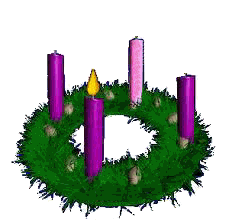
Second Sunday of Advent


Amor (Love)  


Advent
Thomas Merton 

Charm with your stainlessness these winter nights,
Skies, and be perfect! Fly, vivider in the fiery dark, you quiet meteors,
And disappear.
You moon, be slow to go down,
This is your full!

The four white roads make off in silence
Towards the four parts of the starry universe.
Time falls like manna at the corners of the wintry earth.
We have become more humble than the rocks,
More wakeful than the patient hills.

Charm with your stainlessness these nights in Advent,
holy spheres,
While minds, as meek as beasts,
Stay close at home in the sweet hay;
And intellects are quieter than the flocks that feed by starlight.

Oh pour your darkness and your brightness over all our solemn valleys,
You skies: and travel like the gentle Virgin,
Toward the planets’ stately setting,
Oh white full moon as quiet as Bethlehem!


30 November 2025

First Sunday of Advent

Spera (Hope)


Advent
Christina Rossetti 


This Advent moon shines cold and clear,
  These Advent nights are long;
Our lamps have burned year after year
  And still their flame is strong.
'Watchman, what of the night?' we cry,
  Heart-sick with hope deferred:
'No speaking signs are in the sky,'
  Is still the watchman's word.

The Porter watches at the gate,
  The servants watch within;
The watch is long betimes and late,
  The prize is slow to win.
'Watchman, what of the night?' But still
  His answer sounds the same:
'No daybreak tops the utmost hill,
  Nor pale our lamps of flame.'

One to another hear them speak
  The patient virgins wise:
'Surely He is not far to seek'—
  'All night we watch and rise.'
'The days are evil looking back,
  The coming days are dim;
Yet count we not His promise slack,
  But watch and wait for Him.'

One with another, soul with soul,
  They kindle fire from fire:
'Friends watch us who have touched the goal.'
  'They urge us, come up higher.'
'With them shall rest our waysore feet,
  With them is built our home,
With Christ.'—'They sweet, but He most sweet,
  Sweeter than honeycomb.'

There no more parting, no more pain,
  The distant ones brought near,
The lost so long are found again,
  Long lost but longer dear:
Eye hath not seen, ear hath not heard,
  Nor heart conceived that rest,
With them our good things long deferred,
  With Jesus Christ our Best.

We weep because the night is long,
  We laugh for day shall rise,
We sing a slow contented song
  And knock at Paradise.
Weeping we hold Him fast, Who wept
  For us, we hold Him fast;
And will not let Him go except
  He bless us first or last.

Weeping we hold Him fast to-night;
  We will not let Him go
Till daybreak smite our wearied sight
  And summer smite the snow:
Then figs shall bud, and dove with dove
  Shall coo the livelong day;
Then He shall say, 'Arise, My love,
  My fair one, come away.'

(Image: Kim's Cottage Art)

15 December 2024

Third Sunday of Advent

The color of Advent is purple. Purple is for repentance, which is taught how people should be preparing for Christmas. However, there is one exception: the third Sunday of Advent.

Each Sunday has a theme; the first Sunday is Hope, the Second is Peace, and the Fourth is Love. But the Third is Joy, and, because of that, the third candle is pink rather than purple.

Two days ago, the Feast of Santa Lucia occurred. Her feast is celebrated in such varied places as Sicily in Italy and in the Scandinavian nations. On "Lucia Day," it has been traditional for the eldest daughter in a household to arise early, and to serve her mother and father and other elder members of the household coffee and saffron buns called lussekatter for breakfast. The customary costume for this ritual is a white dress with a red sash, and the young woman would wear a crown of candles. These days, to keep down the risk of fire, battery-powered candle crowns are available for those who wish to continue the ritual. Lucia Day celebrates the days now slowly growing longer.

08 December 2024

Second Sunday of Advent

So the first three feast days have passed!

December 4 is the Feast of St. Barbara. She was born into a pagan household, but chose to become a Christian. For this she was tortured by her own father. Miracles delayed some of her torture; wounds from torture carried out healed instantly. Eventually her father had her beheaded, but he was struck by lightning on the way home from her execution.

From Wikipedia: "Saint Barbara is venerated by Catholics who face the danger of sudden and violent death at work. She is invoked against thunder and lightning and all accidents arising from explosions of gunpowder. She became the patron saint of artillerymen, armourers, military engineers, gunsmiths, and anyone else who worked with cannon and explosives.  Following the widespread adoption of gunpowder in mining in the 1600s, she was adopted as the patron of miners, tunnellers, and other underground workers. As the geology and mine engineering developed in association with mining, she became patron of these professions."

December 6, of course, is the feast of St. Nicholas. Those who see him as a jolly Santa Claus type, however, should know he started out as a Turkish bishop. His miracles included saving three students who had been killed and robbed by an evil innkeeper. The innkeeper had chopped up their bodies and brined them, but St. Nicholas returned them to life. The custom of hanging stockings before a fireplace came from the story of St. Nicholas saving three unmarried girls from a poor family from having to be sold into slavery (read: prostitution): supposedly St. Nicholas tossed a bag of gold for each girl into their poverty-stricken home and they ended up in stockings. In places like the Netherlands, where St. Nicholas is the gift bringer, he's usually accompanied by a helper, perhaps Black Peter or Belsnickel or Pelznichol. St. Nicholas rewards the good children while his help punishes the bad.

Today is the feast of the Immaculate Conception. This feast is often confused with the Annunciation and people wonder why Mary the mother of Jesus spent nearly a year pregnant. The Immaculate Conception actually refers to Mary, who was born without sin so she could become the mother of God's son.

From catholic.com: "The Immaculate Conception is a Catholic dogma that states that Mary, whose conception was brought about the normal way, was conceived without original sin or its stain. That’s what 'immaculate' means: without stain.

"When discussing the Immaculate Conception, an implicit reference may be found in the angel’s greeting to Mary. The angel Gabriel said, “Hail, full of grace, the Lord is with you” (Luke 1:28). The phrase 'full of grace' is a translation of the Greek word kecharitomene. It therefore expresses a characteristic quality of Mary."

24 December 2023

Poetry for Christmas: "Christmas Eve"

by Faith Baldwin

The snow is full of silver light
Spilled from the heavens' tilted cup
And, on this holy, tranquil night,
The eyes of men are lifted up
To see the promise written fair,
The hope of peace for all on earth,
And hear the singing bells declare
The marvel of the dear Christ's birth.
The way from year to year is long
And though the road be dark so far,
Bright is the manger, sweet is the song,
The steeple rises to the Star.

21 December 2023

Poetry for Christmas: "The Shortest Day"

Happy Winter Solstice!

by Susan Cooper

And so the Shortest Day came and the year died
And everywhere down the centuries of the snow-white world
Came people singing, dancing,
To drive the dark away.
They lighted candles in the winter trees;
They hung their homes with evergreen;
They burned beseeching fires all night long
To keep the year alive.
And when the new year’s sunshine blazed awake
They shouted, reveling.
Through all the frosty ages you can hear them
Echoing behind us—listen!
All the long echoes, sing the same delight,
This Shortest Day,
As promise wakens in the sleeping land:
They carol, feast, give thanks,
And dearly love their friends,
And hope for peace.
And now so do we, here, now,
This year and every year.

Welcome, Yule!

20 December 2023

Poetry for Christmas: "A Song for a Christmas Tree"

by Louisa May Alcott

Cold and wintry is the sky,
Bitter winds go whistling by,
Orchard boughs are bare and dry,
Yet here stands a faithful tree.
Household fairies kind and dear,
With loving magic none need fear,
Bade it rise and blossom here,
Little friends, for you and me.

Come and gather as they fall,
Shining gifts for great and small;
Santa Claus remembers all
When he comes with goodies piled.
Corn and candy, apples red,
Sugar horses, gingerbread,
Babies who are never fed,
Are handing here for every child.

Shake the boughs and down they come,
Better fruit than peach or plum,
'T is our little harvest home;
For though frosts the flowers kill,
Though birds depart and squirrels sleep,
Though snows may gather cold and deep,
Little folks their sunshine keep,
And mother-love makes summer still.

Gathered in a smiling ring,
Lightly dance and gayly sing,
Still at heart remembering
The sweet story all should know,
Of the little Child whose birth
Has made this day throughout the earth
A festival for childish mirth,
Since the first Christmas long ago.


18 December 2023

The Belgian Detective Sees It Through

CHRISTMAS BOOK REVIEW
Hercule Poirot's Christmas, Agatha Christie
Simeon Lee has a fiendish plan for Christmas: invite all his family, including his estranged sons, to a family reunion. Already home caring for him is his stolid son Alfred and his wife Lydia. Visiting will be George (the cheap one) with his spendthrift wife Magdalene, the artistic David and his wife Hilda who hopes seeing his father will destroy his demons, and his granddaughter Pilar (child of his deceased daughter). Also visiting is Stephen Farr, son of his old partner in his diamond mines day. Simone plans to torment his children with talk about changing his will—but before he can plot any further, he's murdered in a welter of blood in...guess what...a locked room.

Luckily Hercule Poirot is staying nearby with his friend Colonel Johnson (and despairing the lack of central heating). They soon determine that, despite what George keeps wittering about "lunatics" entering the house to kill his father, the culprit must be homegrown. But everyone has a reason for hating Simeon Lee, so the suspects are unlimited.

I know Christie's reputation, and this one doesn't disappoint. The guests don't even get a chance to see the Christmas decorations before the dirty deed is done (not that dad doesn't really deserve it). I had several suspects...and never guessed the real one!

Not much Yuletide cheer, but a nice solid mystery.

15 December 2023

Scrooge, Pickwick, and Other Fellows

CHRISTMAS BOOK REVIEW
Dickens' Christmas, compiled by John Hudson
This is one of the Sutton Christmas anthologies that is not concentrated on a certain shire, but a certain era, and contains compilations from mostly Charles Dickens' Christmas writings (chiefly A Christmas Carol, but also from his monthly magazine "Household Words"), but also has Dickens' era offerings, including the tale of an ordinary man who got himself assigned to one of the terrible workhouses and revealed the crowded and smelly living conditions and meager meals (at one point he says that a candle dipped in boiling water would probably provide more nutrition than the food that was fed the paupers). There's an excerpt from Washington Irving's "Bracebridge Hall" quintet of stories, the scathing poem "Song of the Shirt" about a poor woman receiving hardly enough money from sewing rich people's garments to feed herself, several other workhouse accounts, a lively account of how to give a children's party, and lots of woodcuts and engravings for the era.

I would say pick this one up at a good library book sale.

Poetry for Christmas: "Triolet"

by F. W. Harvey

Winter has hardened all the ground,
     But flowers are on the window pane;
No others are there to be found;
     Winter has hardened all the ground.

But here, while earth is bare and bound,
     Bloom ghosts of those his frost has slain
Winter has hardened all the ground,
     But flowers are on the window pane.

13 December 2023

Poetry for Christmas: "Singing in the Streets"

by Leonard Clark

I had almost forgotten the singing in the streets
Snow piled up by the houses, drifting
Underneath the door into the warm room,
Firelight, lamplight, the little lame cat
Dreaming in soft sleep on the hearth, mother dozing,
Waiting for Christmas to come, the boys and me
Trudging over blanket fields waving lanterns to the sky.
I had almost forgotten the smell, the feel of it all,
The coming back home, with girls laughing like stars,
Their cheeks, holly berries, me kissing one,
Silent-tongued, soberly, by the long church wall;
Then back to the kitchen table, supper on the white cloth,
Cheese, bread, the home-made wine;
Symbols of the night's joy, a whole feast.
And I wonder now, years gone, mother gone,
The boys and girls scattered, drifted away with the snow flakes,
Lamplight done, firelight over,
If the sounds of our singing in the streets are still there,
Those old tunes, still praising;
And now, a life-time of Decembers away from it all,
A branch of remembering holly spears my cheeks,
And I think it may be so;
Yes, I believe it may be so.

03 December 2023

Poetry for Christmas: "The Shepherd's Calendar: December"

by John Clare

Glad Christmas comes, and every hearth
   Makes room to give him welcome now,
E’en want will dry its tears in mirth,
   And crown him with a holly bough;
Though tramping ’neath a winter sky,
   O’er snowy paths and rimy stiles,
The housewife sets her spinning by
   To bid him welcome with her smiles.

Each house is swept the day before,
   And windows stuck with ever-greens,              
The snow is besom’d from the door,
And comfort crowns the cottage scenes.
Gilt holly, with its thorny pricks,
   And yew and box, with berries small,
These deck the unused candlesticks,
   And pictures hanging by the wall.

Neighbours resume their annual cheer,
   Wishing, with smiles and spirits high,
Glad Christmas and a happy year,
   To every morning passer-by;                      
Milkmaids their Christmas journeys go,
   Accompanied with favour’d swain;
And children pace the crumping snow,
   To taste their granny’s cake again.

The shepherd, now no more afraid,
   Since custom doth the chance bestow,
Starts up to kiss the giggling maid
   Beneath the branch of misletoe
That ’neath each cottage beam is seen,
   With pearl-like berries shining gay;            
The shadow still of what hath been,
   Which fashion yearly fades away.

The singing wates, a merry throng,
   At early morn, with simple skill,
Yet imitate the angels song,
   And chant their Christmas ditty still;
And, ’mid the storm that dies and swells
   By fits—in hummings softly steals
The music of the village bells,
   Ringing round their merry peals.
                                         
When this is past, a merry crew,
   Bedeck’d in masks and ribbons gay,
The “Morris-dance,” their sports renew,
   And act their winter evening play.
The clown turn’d king, for penny-praise,
   Storms with the actor’s strut and swell;
And Harlequin, a laugh to raise,
   Wears his hunch-back and tinkling bell.

And oft for pence and spicy ale,
   With winter nosegays pinn’d before,              
The wassail-singer tells her tale,
   And drawls her Christmas carols o’er.
While ’prentice boy, with ruddy face,
   And rime-bepowder’d, dancing locks,
From door to door with happy pace,
   Runs round to claim his “Christmas box.”

The block upon the fire is put,
   To sanction custom’s old desires;
And many a fagot's bands are cut,
   For the old farmers’ Christmas fires;            
Where loud-tongued Gladness joins the throng,
   And Winter meets the warmth of May,
Till feeling soon the heat too strong,
   He rubs his shins, and draws away.

While snows the window-panes bedim,
   The fire curls up a sunny charm,
Where, creaming o’er the pitcher’s rim,
   The flowering ale is set to warm;
Mirth, full of joy as summer bees,
   Sits there, its pleasures to impart,            
And children, ’tween their parent’s knees,
   Sing scraps of carols o’er by heart.

And some, to view the winter weathers,
   Climb up the window-seat with glee,
Likening the snow to falling feathers,
   In Fancy’s infant ecstasy;
Laughing, with superstitious love,
   O’er visions wild that youth supplies,
Of people pulling geese above,
   And keeping Christmas in the skies.              

As tho’ the homestead trees were drest,
   In lieu of snow, with dancing leaves;
As tho’ the sun-dried martin’s nest,
   Instead of i’cles hung the eaves;
The children hail the happy day—
   As if the snow were April’s grass,
And pleas’d, as ’neath the warmth of May,
   Sport o’er the water froze to glass.

Thou day of happy sound and mirth,
   That long with childish memory stays,            
How blest around the cottage hearth
   I met thee in my younger days!
Harping, with rapture’s dreaming joys,
   On presents which thy coming found,
The welcome sight of little toys,
   The Christmas gift of cousins round.

The wooden horse with arching head,
   Drawn upon wheels around the room;
The gilded coach of gingerbread,
   And many-colour’d sugar plum;                    
Gilt cover’d books for pictures sought,
   Or stories childhood loves to tell,
With many an urgent promise bought,
   To get to-morrow’s lesson well.

And many a thing, a minute’s sport,
   Left broken on the sanded floor,
When we would leave our play, and court
   Our parents’ promises for more.
Tho’ manhood bids such raptures die,
   And throws such toys aside as vain,              
Yet memory loves to turn her eye,
   And count past pleasures o’er again.

Around the glowing hearth at night,
   The harmless laugh and winter tale
Go round, while parting friends delight
   To toast each other o’er their ale;
The cotter oft with quiet zeal
   Will musing o’er his Bible lean;
While in the dark the lovers steal
   To kiss and toy behind the screen.  
           
Old customs! Oh! I love the sound,
   However simple they may be:
Whate’er with time hath sanction found,
   Is welcome, and is dear to me.
Pride grows above simplicity,
   And spurns them from her haughty mind,
And soon the poet’s song will be
   The only refuge they can find.

02 December 2023

Poetry for Christmas: "The Christmas Wreath"

A wreath for merry Christmas quickly twine,
A wreath for the bright red sparkling wine,
Though roses are dead
And their bloom is fled,
Yet for Christmas a bonnie, bonnie wreath we'll twine.

Away to the wood where the bright holly grows,
And its red berries blush amid winter snows,
Away to ruin where the green ivy clings,
And around the dark fane its verdure flings;
Hey! for the ivy and holly so bright,
They are the garlands for Christmas night.


Louisa Anne Twamley, 1835

02 September 2023

Sugar and Spice and Ancient Ways

CHRISTMAS BOOK REVIEW
The Secret History of Christmas Baking: Recipes & Stories from Tomb Offerings to Gingerbread Boys
, Linda Raedisch
This is, at its heart, a recipe book, and I don't do recipe books...but-!

This is by the same author who did The Old Magic of Christmas, which is a delightful, nonstandard history of Christmas' pagan antecedents—truly, "not your mother's Christmas book." This volume is about the Christmas standards: stollen, gingerbread, fruitcake, and all, full of the spices and nuts we consider essential to the holiday, and the history of the use of these spices along with the recipes for these items (and more) included. For instance, one used to have to get spices from apothecaries, as they were used in ancient medicines. Raedisch's history begins, indeed, in ancient Egypt, with a recipe using "tiger nuts." Did you know that candy corn was originally invented as a Christmas treat? In the United States, where corn syrup replaced marzipan as a sweetening for the lower classes, the result was candy corn! Also covered is Germany's Christkindl, portrayed by a young woman in a crown, the bleak companions of St. Nicholas who meted out punishments, and finally American contributions to gingerbread lore via the Pennsylvania Dutch.

History and vintage recipes all in one volume! I'm here for the history, but I don't mind the other.

Many thanks to Netgalley for the Advance Reading Copy!

11 December 2022

"Jingle Bells" ... NOT a Christmas Song!

Third Sunday of Advent:


Even though "Jingle Bells" is a universal musical trigger to begin thinking "Christmas," the song, originally called "The One-Horse Open Sleigh," was written by James Lord Pierpont to be sung in a Thanksgiving pageant (in those days of the Little Ice Age, snow in New England and the northern US often started as early as November); indeed, it doesn't mention Christmas at all. It's actually a dating song, the 19th century equivalent of taking your best girl out in your convertible on a summer night. Young ladies were usually not allowed to go out with young men they were not engaged to unless they had a chaperone. However, a one-horse open sleigh, with just room for two and used in public in freezing weather, was considered relatively safe for a young lady to ride with her beau alone. These sleighs were considered the equivalent of sports cars and sleigh racing between young men and their ladies was common. That's why there's a verse about the "bob-tailed nag" who's "2:40 for his speed"—a mile done by a trotting horse in two minutes and forty seconds was considered quite fast in the day.


Other fun facts about sleighs and sleigh bells:

  • Contrary to what you see or hear, roads in those days were not necessarily plowed; instead big shire horses pulled rollers over the snow to smooth it out for sleighing.
  • Sleigh bells were originally made in two halves and soldered together, later bells were cast in one piece. Bells could be either single-throated (with one open slash) or double-throated (with a cross slash).
  • Sleigh bells were originally made like cowbells, and then like cones.
  • There were different brands and types of sleigh bells; some were on the harness, some on the shafts of the sleigh. Brands were Swiss Pole Chimes, Mikado Chimes, King Henry Bells, and Dexter Body Straps. Some sleigh bells, like those of Conestoga wagons, were mounted on an arch of metal over the horse's collar.
  • Sleigh bells weren't put on horses to sound pretty. People all wore thick hats or earmuffs against the cold in those days. A sleigh is a fairly silent vehicle since the runners make almost no sound and the horse's hoofs are muffled by the snow, and they can't stop on a dime. The bells are a safety device to warn pedestrians!


* some facts are from Eric Sloane's The Seasons of America's Past.

05 December 2022

Be Good, Or the Krampus Will Get You!

St. Nicholas, in the "olden days," never traveled alone. Since he was a good and kindly fellow who could never condemn anyone, he required a stern companion to help him handle naughty children. Unlike Black Peter, who accompanied the good Saint in Holland and helped him hand out presents, this companion—known by names like Pelznichol, Belsnickel, Hans Trapp, etc—carried birch rods which were given to parents of naughty children to beat them (the modern equivalent would be the mild "coal in your stocking"). Of all these "punishers," Krampus was the most fearsome: he looked like a cross between a man and a goat, with cloven hooves on his legs, horns on his head, and a big long red tongue that lolled out three to four feet. Originally he took bad children and stuffed them in the big sack he carried upon his back.

This custom died out in the 20th century, but is now being revived, especially in Germanic European countries, as a scary but fun festival at Christmastime.

Krampus

Krampusnacht - December 5, 2022

Krampuslauf 2022 in Salzburg, Austria


04 December 2022

Bayberry ... An Original Christmas Symbol

First Sunday of Advent:


    "Wife make thine owne candle,
    Spare pennie to handle.
    Provide for thy tallow, ere frost cometh in,
    And make thine owne candle, ere winter begin."

                                                        . . . . . Thomas Tusser

From Eric Sloane's The Seasons of America's Past:

Bayberry candles were made during late autumn, when the berries were ripest. The bayberries were thrown into a pot of boiling water, and their fat rose to the top and became a superior candle wax. Bayberry candles burned slowly; they didn't bend or melt during summer heat, and yielded a fine incense, particularly when the candle was snuffed. So prized were bayberry candles that the gathering of berries before autumn in America once brought a fifteen-shilling fine.

The silver-gray berries of scented bayberry, known in England as the "tallow shrub," were for many years sent overseas as Christmas souvenirs from the New World. In the 1700's, the bayberry was more Christmasy than holly (which represents the thorns and blood of the crucifixion rather than the birth of Christ). The burning of a bayberry candle at Christmas was as traditional in America as the burning of a Yule Log in England. "A bayberry candle burned to the socket," an old verse goes, "brings luck to the house and gold to the pocket." Children seldom went to bed on Christmas night without the magic charm of a bayberry candle, and the perfume of the snuffed bayberry candle was part of that magic night.

25 November 2022

Over the Border from Wales

CHRISTMAS BOOK REVIEW
A Monmouthshire Christmas
, Maria & Andrew Hubert
Alan Sutton Publishing has a series of these "Christmas anthologies," the first which I bought at a book sale several years ago, and I try to pick up inexpensive copies when I can find them. Most of them concentrate on a certain shire or area in England, but there are a handful, like A Dickens Christmas and A Bronte Christmas that are set around an historic or literary era instead.

I knew nothing about Monmouthshire, so I was surprised and happy to discover it is just over the border from Wales (and now known as Gwent), so we have several entries about the Welsh Calennig custom (similar to caroling or "souling" in which groups go around offering songs and a decorated apple known as a "Monty"). While many of these books have excerpts from fiction, this book is comprised almost completely of memoirs from people from the early 1900s all the way until the 1960s of the uniquely Welsh customs like Plygain or Mari Lywd; or growing up poor or in orphanages, but still enjoying the small tokens they received at Christmas--one multi-page selection chronicles centuries of entertainment at Tredegar House, the manor house of the Morgans; while the narrative talks about pre-1900 parties, there are photos of 20th century entertainments, too. Caroling, a ghost story at a priory, and some commentary on Tintern Abbey also make for great reading, plus there are photos and engravings galore.

A very interesting volume of holiday memories to start off the season!

25 September 2022

Rudolph Day, September 2022

"Rudolph Day" is a way of keeping the Christmas spirit alive all year long. You can read a Christmas book, work on a Christmas craft project, listen to Christmas music or watch a Christmas movie. This month I've had an ARC to read!

CHRISTMAS BOOK REVIEW
Christmas Past, Brian Earl
Brian Earl has been doing the "Christmas Past" podcast for five years now; it's an enjoyable excursion into the traditions of the Yuletide season. Coming soon is this new book that distills some of his most popular episodes into print.

The book, which I assume is in color, rather than the black and white version presented in the Advance Reader Copy PDF, is excellent for a gift book for someone who's curious about where our Christmas customs come from. I have several books like this (Ace Collins, Clement Miles, Tanya Gulevich, etc.), but this has updated information and also includes modern traditions—most prominently about classic television Christmas animation, but the chapter about the snow globes was fascinating, too.

As Earl points out, a lot of the traditions go back so far that it's difficult to track down exactly where they started. However, I am puzzled by his chapter on "The Twelve Days of Christmas." It is indeed a "forfeit" song, sung for party games, not a Christian metaphor, and I remember singing about "colly birds" (rather than "calling birds") from when I learned the song in the 1960s, but at one point it states "On days six through nine, we have pipers piping and drummers drumming." Actually day six is the geese and day seven is the swans, it's days eight through twelve that are interpreted as other things than birds. (Hallmark's answer to the "five golden rings" in their recent "12 Days of Christmas" ornament set was to make the fifth day a ring-necked pheasant.) I'm not sure how that error made it into the book.

Otherwise, if you've never read a book about the history of Christmas, this is a good place to start; Earl has a nice chatty writing style, and the book is supplemented with illustrations and photographs and cheery graphics.


25 December 2021