Chicken Soup for the Soul: Merry Christmas!, edited by Amy Newmark
So what better place to start Christmas reading than here, 101 (like the Dalmatians) of short, inspirational stories for the holidays (and I mean both, since Hanukkah features many times in this edition, while other Christmas stories have Jewish protagonists participating in the festivities).
What's really to say about these stories? Some are funny, like the one about the woman determined to make the perfect dinner, even though she's not much of a cook, who has the unexpected happen with her Christmas turkey. Others are about people discovering the joys of giving (my favorite part of the holiday!) rather than getting, or about getting through Christmas after a beloved relative or friend has passed on or because they are alone. We learn about a Christmas tree full of heart ornaments, and another in which for a long time all the decorations were simple love notes from a husband to wife and vice versa. There are stories taking place in sunny Arizona, in snowy mountains, on a cruise ship and on a boat. Along the way a dog comments on Christmas cookies, people look at gifts a whole new way, a few marriages change, others cope with a whole new way of life, grandchildren grow and carry on traditions, with the common factor being the Christmas spirit. You can have it with no decorations, or a twig hung with the most unexpected of ornaments, or a tree that won't fit in the space properly, because that's really all that is needed: not gifts, expensive china, turkey dinners or snow.
It's sentimental. Gruff "I hate sentiment" folks are warned. Buy something else that you love to read. But if you want a nice warm fuzzy throw of love, hot cocoa in print, this one will do it for you.
Over the years, Thanksgiving celebrations have changed. If you've read Betty Smith's classic A Tree Grows in Brooklyn, you may remember Francie and Neely going out playing "ragamuffin" on Thanksgiving. Here are photos of the real thing:
This holiday was originally called "Armistice Day" to commemorate the ending of World War I, originally the Great War, which officially ended at 11 a.m. on November 11, 1918 ("the eleventh hour of the eleventh day of the eleventh month"). My parents, who were born in that decade, still called it that even after the name was changed after World War II.
In "my day" (that sounds so pretentious!), this poem was heard at school assemblies every November. We all learned it by heart:
In Flanders fields the poppies blow
Between the crosses, row on row,
That mark our place; and in the sky
The larks, still bravely singing, fly
Scarce heard amid the guns below.
We are the Dead. Short days ago
We lived, felt dawn, saw sunset glow,
Loved and were loved, and now we lie,
In Flanders fields.
Take up our quarrel with the foe:
To you from failing hands we throw
The torch; be yours to hold it high.
If ye break faith with us who die
We shall not sleep, though poppies grow
In Flanders fields.
It's probably the one World War I poem everyone knows. The author was John McCrae, a Canadian, who did not survive the war.
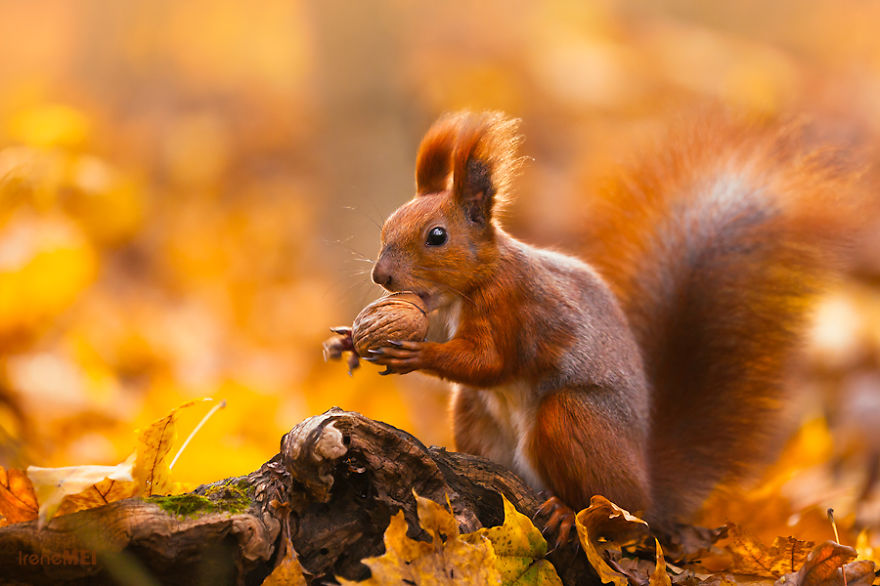
West Highland White in the leaves from Animalfair.com
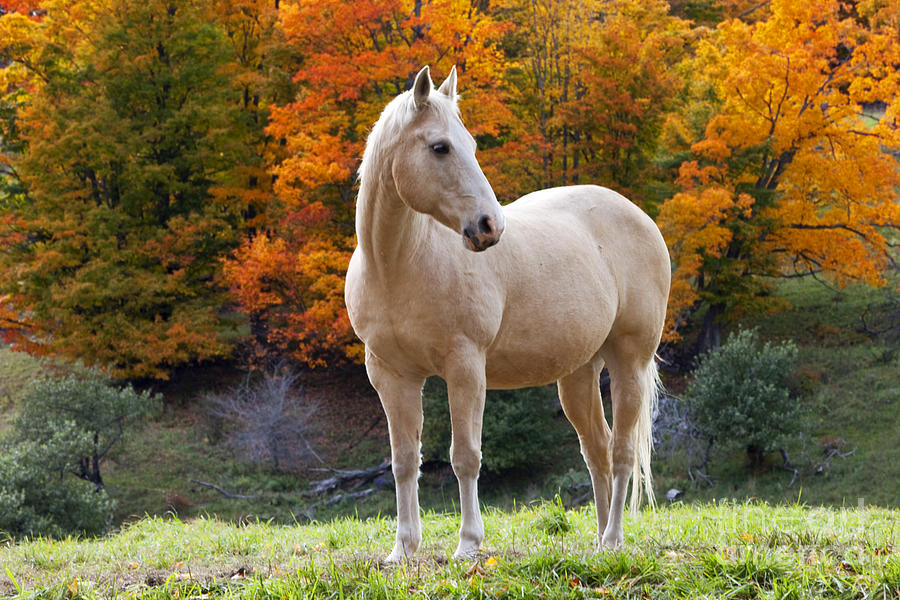
White horse in autumn by Brian Jannsen:
Nothing Gold Can Stay
Robert Frost (1923)
Nature’s first green is gold,
Her hardest hue to hold.
Her early leaf’s a flower;
But only so an hour.
Then leaf subsides to leaf.
So Eden sank to grief,
So dawn goes down to day.
Nothing gold can stay.
God’s World
Edna St. Vincent Millay (from Renascence and Other Poems, 1917)
O world, I cannot hold thee close enough!
Thy winds, thy wide grey skies!
Thy mists, that roll and rise!
Thy woods, this autumn day, that ache and sag
And all but cry with colour! That gaunt crag
To crush! To lift the lean of that black bluff!
World, World, I cannot get thee close enough!
Long have I known a glory in it all,
But never knew I this;
Here such a passion is
As stretcheth me apart,—Lord, I do fear
Thou’st made the world too beautiful this year;
My soul is all but out of me,—let fall
No burning leaf; prithee, let no bird call.
October gave a party;
The leaves by hundreds came-
The Chestnuts, Oaks, and Maples,
And leaves of every name.
The Sunshine spread a carpet,
And everything was grand,
Miss Weather led the dancing,
Professor Wind the band.
The Chestnuts came in yellow,
The Oaks in crimson dressed;
The lovely Misses Maple
In scarlet looked their best;
All balanced to their partners,
And gaily fluttered by;
The sight was like a rainbow
New fallen from the sky.
Then, in the rustic hollow,
At hide-and-seek they played,
The party closed at sundown,
And everybody stayed.
Professor Wind played louder;
They flew along the ground;
And then the party ended
In jolly "hands around."
A Vermont Christmas, Richard Brown and Jay Parini
This is a nifty coffee-table book of mostly photographs—with a difference. Most of the books of this sort are a confection of beautiful decorations, breathtaking scenery, and warm celebrations. There are many photos of scenery in this volume, but most of the photos are of the more "homely" (as the British say) sort: a cow next to an old barn, a minister ready to go before his congregation, a child before an old stove, a man shoveling snow from his roof, sheep in the snow. Some local recipes using maple syrup are included, but most of the text is nostalgic, including a wonderful essay by a woman who lived on a Vermont farm in the 1920s and an excerpt from The Lone Winter from 1923. A book for a cold afternoon, to partake by the fire and/or with a cup of cocoa.