Showing posts with label Candlemas. Show all posts

02 February 2020

Happy Candlemas!

Wait, isn't it "Groundhog Day"?

Well, yes, but the Groundhog Day custom came from Candlemas.

Candlemas is (from Wikipedia):
"also known as the Feast of the Presentation of Jesus Christ and the Feast of the Purification of the Blessed Virgin Mary, is a Christian Holy Day commemorating the presentation of Jesus at the Temple. It is based upon the account of the presentation of Jesus in Luke 2:22–40. In accordance with Leviticus 12: a woman was to be purified by presenting lamb as a burnt offering, and either a young pigeon or dove as sin offering, 33 days after a boy's circumcision. It falls on February 2, which is traditionally the 40th day of and the conclusion of the Christmas–Epiphany season. While it is customary for Christians in some countries to remove their Christmas decorations on Twelfth Night (Epiphany Eve), those in other Christian countries historically remove them on Candlemas. On Candlemas, many Christians (especially Anglicans, Methodists, Lutherans, Orthodox and Roman Catholics) also bring their candles to their local church, where they are blessed and then used for the rest of the year; for Christians, these blessed candles serve as a symbol of Jesus Christ, who referred to Himself as the Light of the World."
Robert Herrick, the late 16th-17th century poet, wrote the following verses about Candlemas:

1. Down with the rosemary and bays,
Down with the mistletoe;
Instead of holly now upraise
The greener box for show.

2. The holly hitherto did sway,
Let box now domineer,
Until the dancing Easter day,
Or Easter's Eve appear.

3. Then youthful box which now hath grace
Your houses to renew,
Grown old, surrender must his place
Unto the crisped yew.

4. When yew is out, then birth comes in,
And many flowers beside,
Both of a fresh and fragrant kin,
To honour Whitsuntide.

5. Green rushes then, and sweetest bents,
With cooler oaken boughs,
Come in for comly ornaments,
To readorn the house.

6. Thus times do shift;
Each thing his turn doth hold;
New things succeed,
As former things grow old.


(If you can't imagine keeping your Christmas decorations up until February 2, remember these customs began in countries where winter was bleak and cold. Bringing greenery into the house—especially greenery that might have bright berries like holly and mistletoe—and decorating fireplace mantels, picture frames, doorways, and windows would have added a cheery air to a dark season. Furthermore, fire-lit homes, while looking cozy in photos, without the backup of central heat or at least a stove, were still quite cold. Historians estimate those cozy images you see of "the little house on the prairie" or other pioneer homes don't pass on the reality that the temperature inside that house was only about 55°F! No wonder they wore long woolen underwear!)

However, the groundhog tradition comes from these old verses about the holiday:

If Candlemas Day be fair and bright,
Winter will have another fight.
If Candlemas Day brings cloud and rain,
Winter won't come again.

or

If Candlemas Day be dry and fair,
The half o the winter's to come and mair;
If Candlemas Day be wet and foul,
The half o the winter's gone at Yule.

German tradition postulated a badger that came out of his burrow on February 2 and either cast a shadow (dry and fair) or did not cast a shadow (rainy, or at least cloudy), and this sign meant the same thing. When Germans first migrated to the United States, they did not see badgers, so the custom was transferred to the woodchuck, commonly known as the groundhog.

Many people read this backward: that the groundhog seeing his shadow means spring is coming, and not seeing his shadow means winter is sticking around. But it is indeed the other way around: if he sees his shadow, the winter chill is continuing and will soon "blow itself out" and spring will come early. If he sees his shadow with the weather being sunny and dry, winter is "taking a breather," then is sure to come back stronger than ever.


20 December 2019

Embrace the Winter!

CHRISTMAS BOOK REVIEW
Merry Midwinter, Gillian Monks
I awarded this book the ultimate accolade: after reading the electronic version, I ordered the "real" book. So this is technically a re-read, although I notice that when I read anything electronic it doesn't feel like I've really read it.

Monks, who describes herself as a Quaker and a practicing Druid (I didn't think that was possible!) has written a great book about celebrating all of the winter holiday season, from Hallowe'en/Samhain all the way through Candlemas, as our ancestors did. She traces the history of all the wonderful customs of the season, from decorating with evergreens (greens which represented both the spirits of nature and the "ever green" eternal love of the Son of God) to celebrating female bringers of light like Saint Lucy and Frau Holle to the connection of the winter solstice to the establishment of Christmas by the Christian Church on a day that was already celebrated as a religious holiday (the Saturnalia of the Romans, the feast of Mithras by the Persians, and ceremonies for the Egyptian Osiris and the Greek god Apollo). And of course she addresses feasting, gift giving, the origins of some of the gift givers, including the now-ubiquitous Santa Claus, snow. As she states "Midwinter has always been a time for people to set aside their differences, lay down their weapons, and come together in a sense of community and celebration."

Her coziest chapters include some of her personal memories of each of the holidays marking the winter season; she once lived along a country road and had the pleasure of gathering her own winter greens like holly and mistletoe. Plus there are family recipes and DIY crafts, but the thing she emphasizes most of all is simplicity and anticipation of each phase of the season: not to rush any part of the winter season, but to enjoy each aspect of it, from the fun of Hallowe'en to the days building up to Christmas, and then not to let Christmas just stop at 11:59 p.m. on December 25, but to celebrate the entire twelve days of Christmastide and even the January days leading finally to Candlemas/Imbolc on the second of February by walking in wintry woods or enjoying the cold weather, and enjoying days doing crafts indoors when the weather is inclement. She firmly believes in the philosophy of "there is no bad weather, only inadequate clothing" and invites you not to bemoan the loss of summer warmth but to embrace the wintry chill. I loved this whole attitude of enjoying all the seasons, not overspending but making some Christmas decorations out of items found from nature (her example which goes throughout the book is having found a large branch just as the leaves were changing and bringing it inside to fasten in a container; she allows the leaves to fall off it naturally, and supplements it with items like acorns and berries in the fall, then tinsel and ornaments and winter-themed items at Christmas, then removes the tinsel and ornaments and just leaves the winter themed items until spring comes and the wood is ready to be recycled into firewood), and also of not allowing Christmas revelry to be trapped in a 24-hour period as our modern society dictates.

At the back of the book there is an extensive calendar of autumn and winter celebrations you can observe, like St. Catherine's Day devoted to reading and learning, St. Cecilia's Day with an emphasis on music, Feast of Fools Day on December 29 when you can go out with tomfoolery, Distaff's Day after Epiphany celebrating your work life, etc.

01 February 2019

"Ceremonies for Candlemas Eve"

by Robert Herrick

Down with the rosemary and bays,
      Down with the misletoe ;
Instead of holly, now up-raise
      The greener box (for show).

The holly hitherto did sway ;
      Let box now domineer
Until the dancing Easter day,
      Or Easter's eve appear.

Then youthful box which now hath grace
      Your houses to renew;
Grown old, surrender must his place
      Unto the crisped yew.

When yew is out, then birch comes in,
      And many flowers beside;
Both of a fresh and fragrant kin
      To honour Whitsuntide.

Green rushes, then, and sweetest bents,
       With cooler oaken boughs,
Come in for comely ornaments
        To re-adorn the house.
Thus times do shift ; each thing his turn does hold;
New things succeed, as former things grow old.

02 February 2017

Candlemas Day is Here Again

February 2 has many names. In the Christian calendar it is Candlemas, Feast of the Presentation of the Lord, which commemorates the presentation of Jesus Christ in the temple, and the purification of the Virgin Mary (a ritual performed the traditional forty days after a boy's birth). Called "Candlemas" because the church's candles were blessed upon that day, you were supposed to toss your used candles and light a fresh, blessed candle instead. (Presumably if you could afford to do so!)

All About Candlemas

Candlemas: From Time and Date

Candlemas Day in Dartmoor, England

Robert Herrick wrote this classic rhyme about Candlemas Day, which was the final day one could keep up Christmas greens without calling down bad luck upon oneself!

Down with the rosemary, and so
Down with the bays and mistletoe;
Down with holly, ivy, all.
Wherewith ye dressed the Christmas Hall;
That so the superstitious find
No one least branch there left behind;
For look, how many leaves there be
Neglected, there (maids trust to me)
So many goblins you shall see.


February 2 is also a ritual feast day in pagan circles, Imbolc. The goddess Brigit's day falls on this date. Many of the traits of Brigit have been carried over to the Irish St. Bridget or Brigid, also called Bride.

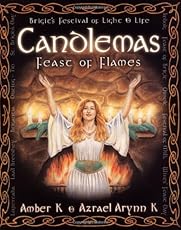
https://images-na.ssl-images-amazon.com/images/I/517%2BuNKBClL._AC_SL230_.jpg
I just finished reading the book at left, which is primarily for those of the Wiccan persuasion; however, it fully explores Brigit's ties with St. Brigid/Bride with a lengthy account of the goddess, her symbols, and the similarities between herself and the saint. Since Candlemas is halfway between the winter solstice and the spring equinox, the day traditionally acknowledges the lengthening of the days and the lessening of winter's grip upon the countryside. Some of the symbols associated with Brigit and Brigid are snowdrops, sheep (lambing signifying the arrival of spring), and cows (freshening due to calving). The book also contains traditional recipes associated with Candlemas, end of winter, spring, and Ireland.

Groundhog Day stems from the belief in Germanic countries that the weather on Candlemas Day predicted the remainder of the season. Their "weather creature," however, was the badger!

The rhyme associated with this event is as follows:

“If Candlemas Day be fair and bright,
Winter will have another fight,
But if Candlemas Day be clouds and rain,
Winter is gone, and will not come again.”

02 February 2016

Candlemas Day


Merry Candlemas! It's Time to Undeck the Halls

Candlemas is a Fitting End to the Traditional Christmas Season

Wait! Does this have something to do with Groundhog Day? Well, yes, in a way:

If Candlemas Day be fair and bright
Winter will have another fight.
If Candlemas Day brings cloud and rain,
Winter won't come again.

The original animal to stick his nose out of his den to see his shadow was the badger.

Celebrating Candlemas - School of the Seasons

BBC: Holy Days, Candlemas

Candlemas Day: The Christian Festival of Lights

Candlemas: Jesus as the Light of the World

Candlemas and Traditions

From Chambers' Book of Days:


CANDLEMASS
From a very early, indeed unknown date in the Christian history, the 2nd of February has been held as the festival of the Purification of the Virgin, and it is still a holiday of the Church of England. From the coincidence of the time with that of the Februation or purification of the people in pagan Rome, some consider this as a Christian festival engrafted upon a heathen one, in order to take advantage of the established habits of the people; but the idea is at least open to a good deal of doubt. The popular name Candlemass is derived from the ceremony which the Church of Rome dictates to be observed on this day; namely, a blessing of candles by the clergy, and a distribution of them amongst the people, by whom they are afterwards carried lighted in solemn procession. The more important observances were of course given up in England at the Reformation; but it was still, about the close of the eighteenth century, customary in some places to light up churches with candles on this day.
At Rome, the Pope every year officiates at this festival in the beautiful chapel of the Quirinal. When he has blessed the candles, he distributes them with his own hand amongst those in the church, each of whom, going singly up to him, kneels to receive it. The cardinals go first; then follow the bishops, canons, priors, abbots, priests, &c., down to the sacristans and meanest officers of the church. According to Lady Morgan, who witnessed the ceremony in 1820:
'When the last of these has gotten his candle, the poor conservatori, the representatives of the Roman senate and people, receive theirs. This ceremony over, the candles are lighted, the Pope is mounted in his chair and carried in procession, with hymns chanting, round the ante-chapel; the throne is stripped of its splendid hangings; the Pope and cardinals take off their gold and crimson dresses, put on their usual robes, and the usual mass of the morning is sung.'
Lady Morgan mentions that similar ceremonies take place in all the parish churches of Rome on this day.
It appears that in England, in Catholic times, a meaning was attached to the size of the candles, and the manner in which they burned during the procession; that, moreover, the reserved parts of the candles were deemed to possess a strong supernatural virtue:
'This done, each man his candle lights,
    Where chiefest seemeth he,
Whose taper greatest may be seen;
    And fortunate to be,
Whose candle burneth clear and bright:
    A wondrous force and might
Both in these candles lie, which if
    At any time they light,
They sure believe that neither storm
    Nor tempest cloth abide,
Nor thunder in the skies be heard,
    Nor any devil's spide,
Nor fearful sprites that walk by night,
    Nor hurts of frost or hail,' &c.

The festival, at whatever date it took its rise, has been designed to commemorate the churching or purification of Mary; and the candle-bearing is understood to refer to what Simeon said when he took the infant Jesus in his arms, and declared that he was a light to lighten the Gentiles. Thus literally to adopt and build upon metaphorical expressions, was a characteristic procedure of the middle ages. Apparently, in consequence of the celebration of Mary's purification by candle-bearing, it became customary for women to carry candles with them, when, after recovery from child-birth, they went to be, as it was called, churched. A remarkable allusion to this custom occurs in English history. William the Conqueror, become, in his elder days, fat and unwieldy, was confined a considerable time by a sickness. 'Methinks,' said his enemy the King of France, 'the Ring of England lies long in childbed.' This being reported to William, he said, 'When I am churched, there shall be a thousand lights in France I' And he was as good as his word; for, as soon as he recovered, he made an inroad into the French territory, which he wasted wherever he went with fire and sword.
At the Reformation, the ceremonials of Candlemass day were not reduced all at once. Henry VIII proclaimed in 1539:
'On Candlemass day it shall be declared, that the bearing of candles is clone in memory of Christ, the spiritual light, whom Simeon did prophesy, as it is read in. the church that day.'
It is curious to find it noticed as a custom down to the time of Charles II, that when lights were brought in at nightfall, people would say—' God send us the light of heaven!' The amiable Herbert, who notices the custom, defends it as not superstitious. Some-what before this time, we find. Herrick alluding to the customs of Candlemass eve: it appears that the plants put up in houses at Christmas were now removed.
Down with the rosemary and bays,
    Down with the mistletoe;
Instead of holly now upraise
    The greener box for show.

The holly hitherto did sway,
    Let box now domineer,
Until the dancing Easter day
    Or Easter's eve appear.

The youthful box, which now hath grace
    Your houses to renew,
Grown old, surrender must his place
    Unto the crisped yew.

When yew is out, then birch comes in,
    And many flowers beside,
Both of a fresh and fragrant kin',
    To honour Whitsuntide.

Greeu rushes then, and sweetest bents,
    With cooler oaken boughs,
Come in for comely ornaments,
    To re-adorn the house.

Thus times do shift; each thing in turn does hold;
New things succeed, as former things grow old.'

The same poet elsewhere recommends very particular care in the thorough removal of the Christmas garnishings on this eve:
'That so the superstitious find
No one least branch left there behind;
For look, how many leaves there be
Neglected there, maids, trust to me,
So many goblins you shall see.'

He also alludes to the reservation of part of the candles or torches, as calculated. to have the effect of protecting from mischief:
'Kindle the Christmas brand, and then
    Till sunset let it burn,
Which quenched, then lay it up again,
    Till Christmas next return.

Part mast be kept, wherewith to tend
    The Christmas log next year;
And where 'tis safely kept, the fiend
    Can do no mischief there.'

There is a curious custom of old standing in Scotland, in connection with Candlemass day. On that day it is, or lately was, an universal practice in that part of the island, for the children attending school to make small presents of money to their teachers. The master sits at his desk or table, exchanging for the moment his usual authoritative look for one of bland civility, and each child goes up in turn and lays his offering down before him, the sum being generally pro-portioned to the abilities of the parents. Six-pence and a shilling are the most common sums in most schools; but some give half and whole crowns, and even more. The boy and girl who give most are respectively styled King and Queen. The children, being then dismissed for a holiday, proceed along the streets in a confused procession, carrying the King and Queen in state, exalted upon that seat formed of crossed hands which, probably from this circumstance, is called the King's Chair. In some schools, it used to be customary for the teacher, on the conclusion of the offerings, to make a bowl of punch and regale each urchin with a glass to drink the King and Queen's health, and a biscuit. The latter part of the day was usually devoted to what was called the Candlemass bleeze, or blaze, namely, the conflagration of any piece of furze which might exist in their neighbourhood, or, were that wanting, of an artificial bonfire.
Another old popular custom in Scotland on Candlemass day was to hold a football match, the east end of a town against the west, the unmarried men against the married, or one parish against another. The 'Candlemass Ba', as it was called, brought the whole community out in a state of high excitement. On one occasion, not long ago, when the sport took place in Jedburgh, the contending parties, after a struggle of two hours in the streets, transferred the contention to the bed of the river Jed, and there fought it out amidst a scene of fearful splash and dabblement, to the infinite amusement of a multitude looking on from the bridge.
Considering the importance attached to Candlemass day for so many ages, it is scarcely surprising that there is a universal superstition throughout Christendom, that good weather on this day indicates a long continuance of winter and a bad crop, and that its being foul is, on the contrary, a good omen. Sir Thomas Browne, in his Vulgar Errors, quotes a Latin distich expressive of this idea:
'Si sol splendescat Maria purificante,
Major erit glacies post festum quam fait ante;

which maybe considered as well translated in the popular Scottish rhyme:
If Candlemass day be dry and fair,
The half o' winter's to come and mair;
If Candlemass day be wet and foul,
The half o' winter's gave at Yule.'

In Germany there are two proverbial expressions on this subject: 1. The shepherd would rather see the wolf cuter his stable on Candlemass day than the sun; 2. The badger peeps out of his hole on Candlemass day, and when he finds snow, walks abroad; but if he sees the sun shining, he draws back into his hole. It is not improbable that these notions, like the festival of Candlemass itself, are derived from pagan times, and have existed since the very infancy of our race. So at least we may conjecture, from a curious passage in Martin's Description of the Western Islands. On Candlemass day, according to this author, the Hebrideans observe the following curious custom:

The mistress and servants of each family take a sheaf of oats and dress it up in women's apparel, put it in a large basket, and lay a wooden club by it, and this they call Brύd's Bed.; and then the mistress and servants cry three times, "Brύd is come; Brύd is welcome!" This they do just before going to bed, and when they rise in the morning they look among the ashes, expecting to see the impression of Brad's club there; which, if they do, they reckon it a true presage of a good crop and prosperous year, and the contrary they take as an ill omen.


02 February 2012

Candles, Groundhogs, and Other Denizens of This Date

There are many names for February 2!


Americans know it as "Groundhog Day" for the odd custom of using the "groundhog" (a.k.a. the woodchuck) to predict the coming of spring. According to the tale, if the groundhog sees his shadow, we will have six more weeks of winter; however, if it is cloudy and there is no shadow, spring is in the offing.

This custom dates back to European folklore, and initally involved a badger. However, the rhyme which goes with the tale is even older. There are several versions, but they all boil down to:

‘If Candlemas day be sunny and bright,
winter will have another flight;
if Candlemas day be cloudy with rain;
winter is gone and won't come again."

The "Candlemas" of the rhyme is the day within the Liturgical Year in which all candles are blessed for the year. The Feast Day being celebrated is the Presentation of Jesus at the Temple or the Purification of the Virgin. It was the custom in those days to present male children at the Temple 40 days after their birth. Since the Liturgical Calendar gives the birthdate of Jesus as December 25, then the date for this event would be February 2.

There are no set customs for Candlemas; however this blog talks about a charming Candlemas tea, and of course, according to the old Robert Herrick verse, all Christmas decorations must be down by this date.

CEREMONIES FOR CANDLEMAS EVE
by Robert Herrick

DOWN with the rosemary and bays,
     Down with the misletoe ;
Instead of holly, now up-raise
     The greener box (for show).

The holly hitherto did sway ;
     Let box now domineer
Until the dancing Easter day,
     Or Easter's eve appear.

Then youthful box which now hath grace
     Your houses to renew ;
Grown old, surrender must his place
     Unto the crisped yew.

When yew is out, then birch comes in,
     And many flowers beside ;
Both of a fresh and fragrant kin
     To honour Whitsuntide.

Green rushes, then, and sweetest bents,
     With cooler oaken boughs,
Come in for comely ornaments
     To re-adorn the house.

Thus times do shift; each thing his turn does hold;
New things succeed, as former things grow old.


If the idea of having Christmas decorations up until February horrifies you, do remember that Christmas decorating was simply sprays of holly, rosemary, and bay leaves around the room, perhaps brightened with a bit of ribbon. In those colder days in homes with no central heat, these evergreens would last pretty well until February 2!

Not to mention that Herrick gives a good list of what would be called today "natural home decorations" through Whitsuntide (Pentecost).

In pre-Christian and non-Christian societies, the holiday was celebrated as Imbolc or Brigid's Day.

Here's the February 2 listing from Chambers' 19th century classic The Book of Days (this whole, fascinating book can be found on Google Books, and has its own website www.bookofdays.com).

And just a few more notes on Groundhog Day via StormFax.

02 February 2010

Shadows and Sunshine

Looks like ol' Punxsatawney Phil has seen his shadow, so the Northeast supposedly will have six more weeks of winter, while General "Beau" Lee did not, which means spring is in the offing. Whatever. We're supposed to get gallons more rain on Thursday and Friday, just a normal winter day in the south.

I've been quiet since Epiphany...just nothing to say. My after-Christmas ennui seems to get worse each year.

Couldn't burn a candle today for Candlemas, so will try to do so tomorrow. My "roasted coffee" candles are almost at an end. Must get more, or the cafè au lait ones. Nothing is as soothing as the smell of brewing coffee.

We are supposed to have a game night next Saturday. The Valentine decorations should be up by then and I hope to do a minor Valentine theme. That should be fun. The day before our game night is the opening ceremonies of the Winter Olympics. We missed most of this last time because of moving, so I'm hoping to enjoy all that snow this year!

02 February 2009

How Much Wood...

Bother. With the weather report the way it is, looks like "General Lee" will not see his shadow. Noooooo! Not spring! Not spring!

Groundhog Day 2009 at the Yellow River Game Ranch

The "official" groundhog, Punxsutawney Phil.

The groundhog tradition comes from beliefs centered on the Christian holiday Candlemas (40 days after Christmas, the day when all Christmas greens must be removed or it will bring bad luck; the name comes from the Church practice of blessing the candles that day for use in the remainder of the liturgical year) and the pagan celebration Imbolc. A Scottish poem says of this day:
"As the light grows longer
The cold grows stronger;
If Candlemas be fair and bright,
Winter will have another flight.
If Candlemas be cloud and snow,
Winter will be gone and not come again.
A farmer should on Candlemas day
Have half his corn and half his hay.
On Candlemas day if thorns hang a drop
You can be sure of a good pea crop."
Early American references to Groundhog Day go back as far as 1841 and state this as a German custom. The original German animal, however, was a badger; once in the United States, the behavior was changed to the groundhog (also known as the woodchuck).

02 February 2006

Candlemas

From The Holiday Page:
...[T]his is really a very old holiday -- one that has its roots in astronomy. February 2nd is one of four cross-quarter days. It lies about halfway between a solstice and an equinox. Today's cross-quarter day was celebrated as Candlemas in England, where it marked the beginning of spring.

Try this old English rhyme -- "If Candlemas Day be fair and bright, winter will have another flight. But if it be dark with clouds and rain, winter is gone and will not come again."

Or here's another old saying -- "Half your wood and half your hay, You should have on Candlemas Day."

In Germany it used to be said that "a shepherd would rather see a wolf enter his stable on Candlemas Day than see the sun shine." A German badger was said to watch for his shadow. The National Geographic Society once studied the groundhog -- and found him to be correct only one out of every three times. One final note. It's supposed to be bad luck to leave your Christmas decorations up after today.
As you can see, the old English rhyme (and another, similar, Scottish rhyme) form the basis for Groundhog Day, which is chiefly celebrated in the United States. However, the folks in Canada also have a groundhog, Wiarton Willie. In the Southern United States, there is "General Beau Lee," who lives at the Yellow River Game Ranch in Stone Mountain, Georgia.

Stormfax's Groundhog Day Site contains more info about Punxsutawney Phil, the "official" groundhog, the Candlemas rhymes, and even some info about the Bill Murray movie Groundhog Day. And of course here is Phil's official site.

This is a Catholic page about Candlemas history and customs.

Circle Sanctuary's site covers all the different customs surrounding February 2, Christian, pagan, and secular.