Showing posts with label Christmastide. Show all posts

02 December 2023

Poetry for Christmas: "The Christmas Wreath"

A wreath for merry Christmas quickly twine,
A wreath for the bright red sparkling wine,
Though roses are dead
And their bloom is fled,
Yet for Christmas a bonnie, bonnie wreath we'll twine.

Away to the wood where the bright holly grows,
And its red berries blush amid winter snows,
Away to ruin where the green ivy clings,
And around the dark fane its verdure flings;
Hey! for the ivy and holly so bright,
They are the garlands for Christmas night.


Louisa Anne Twamley, 1835

11 December 2022

"Jingle Bells" ... NOT a Christmas Song!

Third Sunday of Advent:


Even though "Jingle Bells" is a universal musical trigger to begin thinking "Christmas," the song, originally called "The One-Horse Open Sleigh," was written by James Lord Pierpont to be sung in a Thanksgiving pageant (in those days of the Little Ice Age, snow in New England and the northern US often started as early as November); indeed, it doesn't mention Christmas at all. It's actually a dating song, the 19th century equivalent of taking your best girl out in your convertible on a summer night. Young ladies were usually not allowed to go out with young men they were not engaged to unless they had a chaperone. However, a one-horse open sleigh, with just room for two and used in public in freezing weather, was considered relatively safe for a young lady to ride with her beau alone. These sleighs were considered the equivalent of sports cars and sleigh racing between young men and their ladies was common. That's why there's a verse about the "bob-tailed nag" who's "2:40 for his speed"—a mile done by a trotting horse in two minutes and forty seconds was considered quite fast in the day.


Other fun facts about sleighs and sleigh bells:

  • Contrary to what you see or hear, roads in those days were not necessarily plowed; instead big shire horses pulled rollers over the snow to smooth it out for sleighing.
  • Sleigh bells were originally made in two halves and soldered together, later bells were cast in one piece. Bells could be either single-throated (with one open slash) or double-throated (with a cross slash).
  • Sleigh bells were originally made like cowbells, and then like cones.
  • There were different brands and types of sleigh bells; some were on the harness, some on the shafts of the sleigh. Brands were Swiss Pole Chimes, Mikado Chimes, King Henry Bells, and Dexter Body Straps. Some sleigh bells, like those of Conestoga wagons, were mounted on an arch of metal over the horse's collar.
  • Sleigh bells weren't put on horses to sound pretty. People all wore thick hats or earmuffs against the cold in those days. A sleigh is a fairly silent vehicle since the runners make almost no sound and the horse's hoofs are muffled by the snow, and they can't stop on a dime. The bells are a safety device to warn pedestrians!


* some facts are from Eric Sloane's The Seasons of America's Past.

01 January 2022

Happy New Year!


25 December 2021


25 July 2021

Christmas in July

CHRISTMAS BOOK REVIEW 
The Atlas of Christmas: The Merriest, Tastiest, Quirkiest Holiday Traditions from Around the World, Alex Palmer
I've been collecting Christmas books for 20-30 years now, so a lot of the customs talked about in this book I already know...but it's still a nifty little volume, because there are so many holiday customs I didn't know about as well. The book is divided into nine parts: Ceremonies and Rituals (Three Kings Day and Santa Lucia, among others), Musical Interludes and Interlopers (bagpipes in Italy rather than Scotland and mumming in Newfoundland), Local Quirks and Curious Practices (the much-vaunted Christmas book flood in Iceland along with Finnish saunas and a "poop log" in Spain), Saints and Gift Bringers (alternate Santa like La Befana, Frau Holle, Tante Arie, and even some male ones), Devils and Troublemakers (here comes Krampus with his long tongue and bag for naughty children and the problem with "Black Peter"), Holiday Trimmings and Trinkets (beautiful lanterns in the Philippines, a Yule goat, and a wheat chandelier), Fierce Competitions and Leisurely Pastimes (Christmas verse with a difference in the Netherlands and Christmas crackers), Savory and Satisfying Holiday Dishes (holiday foods...), and Celebratory Sweets (...and desserts and drinks).
 
This book includes a lot of new traditions from Africa and the Middle East that I'd never heard of, even a Chinese custom of giving apples during the holiday season, despite the government's efforts to suppress Western holidays. If you don't have any other books about Christmas customs in other lands, this would be a great starter volume for reading about world holiday customs. It's illustrated with quaint little cutout paper type illustrations, although photos of some of the food would have been cool. The only problem is that someone appeared to quit proofreading the book about halfway through and there are references to other articles that say "see page TK," but this doesn't spoil the narrative. Also, they seemed to skip the German custom of the peppermint pig.

(Incidentally, the story you hear about the custom of the pickle ornament on German Christmas trees is not here, as Germans say it's not a German custom.)


A Christmas Legacy, Anne Perry
This is this year's Christmas book from Perry, who is most famous for her two Victorian mystery series: the later set Charlotte and Thomas Pitt stories starting with The Cater Street Hangman and the earlier set William Monk/Hester Latterley novels starting with Face of A Stranger. In each of the books she has a usually minor character from one of the two series facing some sort of problem during the Yuletide season.

A Christmas Legacy stars one of Perry's most beloved supporting characters, Gracie Phipps Tellman, once the teenage servant of the Pitts. Now married to Thomas Pitt's old partner on the Metropolitan Police, Samuel Tellman, with three children (Charlotte "Charlie," Thomas, and Victor), Gracie takes pity on Millie Foster, whose mother she and Tellman had helped when Millie was a child. Millie works as a maid for a wealthy family and things like food are disappearing from the kitchen. She's afraid something odd is going on and the servants will be blamed for it, and she's desperate for someone to help. If one of the servants gets dismissed without a character reference, they will likely spend the rest of their lives on the street. So Gracie concocts a story that Millie is ill, produces a character reference from Charlotte Pitt, and with her husband's blessing, takes Millie's place at the Harcourt home. She promises Tellman and little Charlie she will be home for Christmas, but is immediately swept up in the problems Millie has spoken about, and can't figure out for the life of her what's going on...but it has to do with the food, and something upstairs.

I think readers will guess pretty quickly what's going on after Gracie finds out the secret of the food and especially after a conversation between the Harcourts, but it's the humanity of Gracie's reaction once she discovers the problem and the actions of the servants that carry this book. The actual mystery is a bit cliche, but it's all heartwarming, and Charlie is a darling character. I really wish Perry would write some books about Tellman's cases and how Gracie has helped him, as they intimate she has in at least one case with Millie's mother, as I find Gracie and Tellman both more interesting than her newest character, Elena Standish.

29 November 2020

First Sunday of Advent

Theme: Hope (and boy, do we need it this year).

You never take a vacation without preparation.

Neither do most people go into Christmas without a little preparation. Shopping, baking, wrapping, decorating, and more are all part of Christmas prep. But if you celebrate Christmas as a religious holiday, there's more to it than that. Advent is a time of reflection, to prepare hearts for the birth of Jesus Christ.

Advent was originally a 40-day period, like Lent, and fasting, except on Sunday, was common. Now Advent begins on the fourth Sunday before Christmas. The longest Advent period happens when Christmas is on a Sunday, and begins November 27. The shortest Advent happens when Christmas is on Monday, beginning December 3.

Several Christmas-y holidays fall within the Advent period, including St. Nicholas Day and St. Lucia Day. St. Thomas' Day also used to be a pre-Christmas holiday until the church moved it to another month. "Thomasing" was practiced as children went "a'souling" for soul cakes on that day, a combination of trick or treating and caroling.

Here are some Advent and Christmas customs in other countries:

• Advent Period Begins: The Most Beautiful Hungarian Christmas Traditions

• Advent Traditions in Germany

• Six Quirky Italian Advent Traditions

• A Guide to Advent in Britain

• How Do We Celebrate Advent in France? 

• Seven Unique Spanish Christmas Traditions 

• 25 Surprising Facts about Christmas in the Netherlands 

• Christmas in Brazil 

• Posadas and Other Mexican Christmas Traditions

02 February 2020

Happy Candlemas!

Wait, isn't it "Groundhog Day"?

Well, yes, but the Groundhog Day custom came from Candlemas.

Candlemas is (from Wikipedia):
"also known as the Feast of the Presentation of Jesus Christ and the Feast of the Purification of the Blessed Virgin Mary, is a Christian Holy Day commemorating the presentation of Jesus at the Temple. It is based upon the account of the presentation of Jesus in Luke 2:22–40. In accordance with Leviticus 12: a woman was to be purified by presenting lamb as a burnt offering, and either a young pigeon or dove as sin offering, 33 days after a boy's circumcision. It falls on February 2, which is traditionally the 40th day of and the conclusion of the Christmas–Epiphany season. While it is customary for Christians in some countries to remove their Christmas decorations on Twelfth Night (Epiphany Eve), those in other Christian countries historically remove them on Candlemas. On Candlemas, many Christians (especially Anglicans, Methodists, Lutherans, Orthodox and Roman Catholics) also bring their candles to their local church, where they are blessed and then used for the rest of the year; for Christians, these blessed candles serve as a symbol of Jesus Christ, who referred to Himself as the Light of the World."
Robert Herrick, the late 16th-17th century poet, wrote the following verses about Candlemas:

1. Down with the rosemary and bays,
Down with the mistletoe;
Instead of holly now upraise
The greener box for show.

2. The holly hitherto did sway,
Let box now domineer,
Until the dancing Easter day,
Or Easter's Eve appear.

3. Then youthful box which now hath grace
Your houses to renew,
Grown old, surrender must his place
Unto the crisped yew.

4. When yew is out, then birth comes in,
And many flowers beside,
Both of a fresh and fragrant kin,
To honour Whitsuntide.

5. Green rushes then, and sweetest bents,
With cooler oaken boughs,
Come in for comly ornaments,
To readorn the house.

6. Thus times do shift;
Each thing his turn doth hold;
New things succeed,
As former things grow old.


(If you can't imagine keeping your Christmas decorations up until February 2, remember these customs began in countries where winter was bleak and cold. Bringing greenery into the house—especially greenery that might have bright berries like holly and mistletoe—and decorating fireplace mantels, picture frames, doorways, and windows would have added a cheery air to a dark season. Furthermore, fire-lit homes, while looking cozy in photos, without the backup of central heat or at least a stove, were still quite cold. Historians estimate those cozy images you see of "the little house on the prairie" or other pioneer homes don't pass on the reality that the temperature inside that house was only about 55°F! No wonder they wore long woolen underwear!)

However, the groundhog tradition comes from these old verses about the holiday:

If Candlemas Day be fair and bright,
Winter will have another fight.
If Candlemas Day brings cloud and rain,
Winter won't come again.

or

If Candlemas Day be dry and fair,
The half o the winter's to come and mair;
If Candlemas Day be wet and foul,
The half o the winter's gone at Yule.

German tradition postulated a badger that came out of his burrow on February 2 and either cast a shadow (dry and fair) or did not cast a shadow (rainy, or at least cloudy), and this sign meant the same thing. When Germans first migrated to the United States, they did not see badgers, so the custom was transferred to the woodchuck, commonly known as the groundhog.

Many people read this backward: that the groundhog seeing his shadow means spring is coming, and not seeing his shadow means winter is sticking around. But it is indeed the other way around: if he sees his shadow, the winter chill is continuing and will soon "blow itself out" and spring will come early. If he sees his shadow with the weather being sunny and dry, winter is "taking a breather," then is sure to come back stronger than ever.

20 December 2019

Embrace the Winter!

CHRISTMAS BOOK REVIEW
Merry Midwinter, Gillian Monks
I awarded this book the ultimate accolade: after reading the electronic version, I ordered the "real" book. So this is technically a re-read, although I notice that when I read anything electronic it doesn't feel like I've really read it.

Monks, who describes herself as a Quaker and a practicing Druid (I didn't think that was possible!) has written a great book about celebrating all of the winter holiday season, from Hallowe'en/Samhain all the way through Candlemas, as our ancestors did. She traces the history of all the wonderful customs of the season, from decorating with evergreens (greens which represented both the spirits of nature and the "ever green" eternal love of the Son of God) to celebrating female bringers of light like Saint Lucy and Frau Holle to the connection of the winter solstice to the establishment of Christmas by the Christian Church on a day that was already celebrated as a religious holiday (the Saturnalia of the Romans, the feast of Mithras by the Persians, and ceremonies for the Egyptian Osiris and the Greek god Apollo). And of course she addresses feasting, gift giving, the origins of some of the gift givers, including the now-ubiquitous Santa Claus, snow. As she states "Midwinter has always been a time for people to set aside their differences, lay down their weapons, and come together in a sense of community and celebration."

Her coziest chapters include some of her personal memories of each of the holidays marking the winter season; she once lived along a country road and had the pleasure of gathering her own winter greens like holly and mistletoe. Plus there are family recipes and DIY crafts, but the thing she emphasizes most of all is simplicity and anticipation of each phase of the season: not to rush any part of the winter season, but to enjoy each aspect of it, from the fun of Hallowe'en to the days building up to Christmas, and then not to let Christmas just stop at 11:59 p.m. on December 25, but to celebrate the entire twelve days of Christmastide and even the January days leading finally to Candlemas/Imbolc on the second of February by walking in wintry woods or enjoying the cold weather, and enjoying days doing crafts indoors when the weather is inclement. She firmly believes in the philosophy of "there is no bad weather, only inadequate clothing" and invites you not to bemoan the loss of summer warmth but to embrace the wintry chill. I loved this whole attitude of enjoying all the seasons, not overspending but making some Christmas decorations out of items found from nature (her example which goes throughout the book is having found a large branch just as the leaves were changing and bringing it inside to fasten in a container; she allows the leaves to fall off it naturally, and supplements it with items like acorns and berries in the fall, then tinsel and ornaments and winter-themed items at Christmas, then removes the tinsel and ornaments and just leaves the winter themed items until spring comes and the wood is ready to be recycled into firewood), and also of not allowing Christmas revelry to be trapped in a 24-hour period as our modern society dictates.

At the back of the book there is an extensive calendar of autumn and winter celebrations you can observe, like St. Catherine's Day devoted to reading and learning, St. Cecilia's Day with an emphasis on music, Feast of Fools Day on December 29 when you can go out with tomfoolery, Distaff's Day after Epiphany celebrating your work life, etc.

30 November 2019

"We'll Keep Our Christmas Merry Still..."

from Marmion by Sir Walter Scott

Heap on more wood!-the wind is chill;
But let it whistle as it will,
We’ll keep our Christmas merry still.
Each age has deem’d the new-born year
The fittest time for festal cheer:
Even, heathen yet, the savage Dane
At Iol more deep the mead did drain;
High on the beach his galleys drew,
And feasted all his pirate crew;
hen in his low and pine-built hall,
Where shields and axes deck’d the wall,
They gorged upon the half-dress’d steer;
Caroused in seas of sable beer;
While round, in brutal jest, were thrown
The half-gnaw’d rib, and marrow-bone,
Or listen’d all, in grim delight,
While scalds yell’d out the joys of fight.
Then forth, in frenzy, would they hie,
While wildly-loose their red locks fly,
And dancing round the blazing pile,
They make such barbarous mirth the while,
As best might to the mind recall
The boisterous joys of Odin’s hall.

And well our Christian sires of old
Loved when the year its course had roll’d,
And brought blithe Christmas back again,
With all his hospitable train.
Domestic and religious rite
Gave honour to the holy night;
On Christmas eve the bells were rung;
On Christmas eve the mass was sung:
That only night in all the year,
Saw the stoled priest the chalice rear.
The damsel donn’d her kirtle sheen;
The hall was dress’d with holly green;
Forth to the wood did merry-men go,
To gather in the mistletoe.
Then open’d wide the Baron’s hall
To vassal, tenant, serf, and all;
Power laid his rod of rule aside,
And Ceremony doff’d his pride.
The heir, with roses in his shoes,
That night might village partner choose;
The Lord, underogating, share
The vulgar game of ‘post and pair.’
All hail’d, with uncontroll’d delight,
And general voice, the happy night,
That to the cottage, as the crown,
Brought tidings of salvation down.

The fire, with well-dried logs supplied,
Went roaring up the chimney wide:
The huge hall-table’s oaken face,
Scrubb’d till it shone, the day to grace,
Bore then upon its massive board
No mark to part the squire and lord.
 Then was brought in the lusty brawn,
By old blue-coated serving-man;
Then the grim boar’s head frown’d on high,
Crested with bays and rosemary.
Well can the green-garb’d ranger tell,
How, when, and where, the monster fell;
What dogs before his death he tore,
And all the baiting of the boar.
The wassel round, in good brown bowls,
Garnish’d with ribbons, blithely trowls.
There the huge sirloin reek’d; hard by
Plum-porridge stood, and Christmas pie:
Nor fail’d old Scotland to produce,
At such high tide, her savoury goose.
Then came the merry maskers in,
And carols roar’d with blithesome din;
If unmelodious was the song,
It was a hearty note, and strong.
Who lists may in their mumming see
Traces of ancient mystery;
White shirts supplied the masquerade,
And smutted cheeks the visors made;
But, O! what maskers, richly dight,
Can boast of bosoms half so light!
England was merry England, when
Old Christmas brought his sports again.
‘Twas Christmas broach’d the mightiest ale;
‘Twas Christmas told the merriest tale;
A Christmas gambol oft could cheer
The poor man’s heart through half the year.           

06 January 2019

"Farewell to Christmas"

Noël is leaving us,
Sad it is to tell,
But he will come again,
Adieu, Noël.

His wife and his children
Weep as they go.
On a gray horse,
They ride through the snow.

The kings ride away
In the snow and the rain,
After twelve months,
We shall see them again.


French Epiphany Carol, quoted in Celebrate the Wonder

05 January 2019

"The Three Kings"

By Henry Wadsworth Longfellow

Three Kings came riding from far away,
Melchior and Gaspar and Baltasar;
Three Wise Men out of the East were they,
And they travelled by night and they slept by day,
For their guide was a beautiful, wonderful star.


The star was so beautiful, large and clear,
That all the other stars of the sky
Became a white mist in the atmosphere,
And by this they knew that the coming was near
Of the Prince foretold in the prophecy.

Three caskets they bore on their saddle-bows,
Three caskets of gold with golden keys;
Their robes were of crimson silk with rows
Of bells and pomegranates and furbelows,
Their turbans like blossoming almond-trees.

And so the Three Kings rode into the West,
Through the dusk of the night, over hill and dell,
And sometimes they nodded with beard on breast,
And sometimes talked, as they paused to rest,
With the people they met at some wayside well.

“Of the child that is born,” said Baltasar,
“Good people, I pray you, tell us the news;
For we in the East have seen his star,
And have ridden fast, and have ridden far,
To find and worship the King of the Jews.”

And the people answered, “You ask in vain;
We know of no King but Herod the Great!”
They thought the Wise Men were men insane,
As they spurred their horses across the plain,
Like riders in haste, who cannot wait.

And when they came to Jerusalem,
Herod the Great, who had heard this thing,
Sent for the Wise Men and questioned them;
And said, “Go down unto Bethlehem,
And bring me tidings of this new king.”

So they rode away; and the star stood still,
The only one in the grey of morn;
Yes, it stopped—it stood still of its own free will,
Right over Bethlehem on the hill,
The city of David, where Christ was born.

And the Three Kings rode through the gate and the guard,
Through the silent street, till their horses turned
And neighed as they entered the great inn-yard;
But the windows were closed, and the doors were barred,
And only a light in the stable burned.

And cradled there in the scented hay,
In the air made sweet by the breath of kine,
The little child in the manger lay,
The child, that would be king one day
Of a kingdom not human, but divine.

His mother Mary of Nazareth
Sat watching beside his place of rest,
Watching the even flow of his breath,
For the joy of life and the terror of death
Were mingled together in her breast.

They laid their offerings at his feet:
The gold was their tribute to a King,
The frankincense, with its odor sweet,
Was for the Priest, the Paraclete,
The myrrh for the body’s burying.

And the mother wondered and bowed her head,
And sat as still as a statue of stone,
Her heart was troubled yet comforted,
Remembering what the Angel had said
Of an endless reign and of David’s throne.

Then the Kings rode out of the city gate,
With a clatter of hoofs in proud array;
But they went not back to Herod the Great,
For they knew his malice and feared his hate,
And returned to their homes by another way.

02 January 2019

Two Readings for Advent and Christmastide

CHRISTMAS BOOK REVIEW
Goodness and Light: Readings for Advent and Christmas, edited by Michael Leach, James Keane, and Doris Goodnough
Preparing My Heart for Advent, Ann Marie Stewart
When I saw these both at the same book sale, I figured it was fate. Here was something I could do for Advent and Christmastide, one reading a day until Christmas from each.

Alas, the spirit was willing, but the flesh was still juggling too many things. I skipped the books totally last year after starting the second one, and waded in with good intentions on November first. One would have ended on Sunday, the other on Monday, but since this weekend will be busy I just sat quietly today and finished the readings from Christmas Day onward. Perhaps next year.

Goodness and Light is a small book with one essay a day starting November 1 and finishing on St. Distaff's Day (January 7). These range from poetry to essays to a couple of short stories, one of which, Cheever's "Christmas is a Sad Time for the Poor," I didn't think was really representative of the rest of the theme. However, "Papa Panov's Special Christmas" was quite welcome. Some of the essays are by religious figures who were missionaries put into prison; some are totally unexpected, like one from Anne Rice who became a born-again Christian after writing her famous vampire books. There are some well-known names here: Maya Angelou, Pope Francis, Annie Dillard, even one by Ghandi, but it's the sometimes small ones that captured my attention, like "Holy Innocents" for the 28th of December, or "Salvation Army Santa Claus Rings His Bell."

Preparing My Heart for Advent is partially a Bible study and workbook. You begin on November 1 reading from the Bible and doing the daily exercises. These readings of the old and new Testaments explain the background behind the coming of the Messiah: the prophecies, the history, the primary and secondary figures in what we call "the Christmas story," hymns, etc. From December 1 through Epiphany there are daily devotions, each with a Bible verse, a Reflection and finally a Response (prayer).

If you are looking for a more spiritual experience at Christmas, both these books are recommended. If you wish to delve a little more into Biblical study, the second book would be an appropriate choice.

01 January 2018


28 December 2017

Childermas Day

Childermas, or Holy Innocents Day, commemorates the slaughter of the children by the orders of Herod the Great after he was visited by the Magi following the star to the birthplace of the infant Jesus. Because of the horrific associations of the day, it is said to be bad luck to start on a project on this day.


Massacre of the Innocents - Wikipedia

Liturgical Year: Holy Innocents Day

Feasts and Festivals: Holy Innocents


02 February 2017

Candlemas Day is Here Again

February 2 has many names. In the Christian calendar it is Candlemas, Feast of the Presentation of the Lord, which commemorates the presentation of Jesus Christ in the temple, and the purification of the Virgin Mary (a ritual performed the traditional forty days after a boy's birth). Called "Candlemas" because the church's candles were blessed upon that day, you were supposed to toss your used candles and light a fresh, blessed candle instead. (Presumably if you could afford to do so!)

All About Candlemas

Candlemas: From Time and Date

Candlemas Day in Dartmoor, England

Robert Herrick wrote this classic rhyme about Candlemas Day, which was the final day one could keep up Christmas greens without calling down bad luck upon oneself!

Down with the rosemary, and so
Down with the bays and mistletoe;
Down with holly, ivy, all.
Wherewith ye dressed the Christmas Hall;
That so the superstitious find
No one least branch there left behind;
For look, how many leaves there be
Neglected, there (maids trust to me)
So many goblins you shall see.


February 2 is also a ritual feast day in pagan circles, Imbolc. The goddess Brigit's day falls on this date. Many of the traits of Brigit have been carried over to the Irish St. Bridget or Brigid, also called Bride.

https://images-na.ssl-images-amazon.com/images/I/517%2BuNKBClL._AC_SL230_.jpg
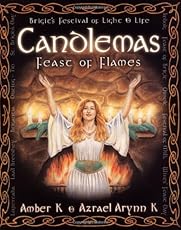
I just finished reading the book at left, which is primarily for those of the Wiccan persuasion; however, it fully explores Brigit's ties with St. Brigid/Bride with a lengthy account of the goddess, her symbols, and the similarities between herself and the saint. Since Candlemas is halfway between the winter solstice and the spring equinox, the day traditionally acknowledges the lengthening of the days and the lessening of winter's grip upon the countryside. Some of the symbols associated with Brigit and Brigid are snowdrops, sheep (lambing signifying the arrival of spring), and cows (freshening due to calving). The book also contains traditional recipes associated with Candlemas, end of winter, spring, and Ireland.

Groundhog Day stems from the belief in Germanic countries that the weather on Candlemas Day predicted the remainder of the season. Their "weather creature," however, was the badger!

The rhyme associated with this event is as follows:

“If Candlemas Day be fair and bright,
Winter will have another fight,
But if Candlemas Day be clouds and rain,
Winter is gone, and will not come again.”

02 February 2016

Candlemas Day


Merry Candlemas! It's Time to Undeck the Halls

Candlemas is a Fitting End to the Traditional Christmas Season

Wait! Does this have something to do with Groundhog Day? Well, yes, in a way:

If Candlemas Day be fair and bright
Winter will have another fight.
If Candlemas Day brings cloud and rain,
Winter won't come again.

The original animal to stick his nose out of his den to see his shadow was the badger.

Celebrating Candlemas - School of the Seasons

BBC: Holy Days, Candlemas

Candlemas Day: The Christian Festival of Lights

Candlemas: Jesus as the Light of the World

Candlemas and Traditions

From Chambers' Book of Days:


CANDLEMASS
From a very early, indeed unknown date in the Christian history, the 2nd of February has been held as the festival of the Purification of the Virgin, and it is still a holiday of the Church of England. From the coincidence of the time with that of the Februation or purification of the people in pagan Rome, some consider this as a Christian festival engrafted upon a heathen one, in order to take advantage of the established habits of the people; but the idea is at least open to a good deal of doubt. The popular name Candlemass is derived from the ceremony which the Church of Rome dictates to be observed on this day; namely, a blessing of candles by the clergy, and a distribution of them amongst the people, by whom they are afterwards carried lighted in solemn procession. The more important observances were of course given up in England at the Reformation; but it was still, about the close of the eighteenth century, customary in some places to light up churches with candles on this day.
At Rome, the Pope every year officiates at this festival in the beautiful chapel of the Quirinal. When he has blessed the candles, he distributes them with his own hand amongst those in the church, each of whom, going singly up to him, kneels to receive it. The cardinals go first; then follow the bishops, canons, priors, abbots, priests, &c., down to the sacristans and meanest officers of the church. According to Lady Morgan, who witnessed the ceremony in 1820:
'When the last of these has gotten his candle, the poor conservatori, the representatives of the Roman senate and people, receive theirs. This ceremony over, the candles are lighted, the Pope is mounted in his chair and carried in procession, with hymns chanting, round the ante-chapel; the throne is stripped of its splendid hangings; the Pope and cardinals take off their gold and crimson dresses, put on their usual robes, and the usual mass of the morning is sung.'
Lady Morgan mentions that similar ceremonies take place in all the parish churches of Rome on this day.
It appears that in England, in Catholic times, a meaning was attached to the size of the candles, and the manner in which they burned during the procession; that, moreover, the reserved parts of the candles were deemed to possess a strong supernatural virtue:
'This done, each man his candle lights,
    Where chiefest seemeth he,
Whose taper greatest may be seen;
    And fortunate to be,
Whose candle burneth clear and bright:
    A wondrous force and might
Both in these candles lie, which if
    At any time they light,
They sure believe that neither storm
    Nor tempest cloth abide,
Nor thunder in the skies be heard,
    Nor any devil's spide,
Nor fearful sprites that walk by night,
    Nor hurts of frost or hail,' &c.

The festival, at whatever date it took its rise, has been designed to commemorate the churching or purification of Mary; and the candle-bearing is understood to refer to what Simeon said when he took the infant Jesus in his arms, and declared that he was a light to lighten the Gentiles. Thus literally to adopt and build upon metaphorical expressions, was a characteristic procedure of the middle ages. Apparently, in consequence of the celebration of Mary's purification by candle-bearing, it became customary for women to carry candles with them, when, after recovery from child-birth, they went to be, as it was called, churched. A remarkable allusion to this custom occurs in English history. William the Conqueror, become, in his elder days, fat and unwieldy, was confined a considerable time by a sickness. 'Methinks,' said his enemy the King of France, 'the Ring of England lies long in childbed.' This being reported to William, he said, 'When I am churched, there shall be a thousand lights in France I' And he was as good as his word; for, as soon as he recovered, he made an inroad into the French territory, which he wasted wherever he went with fire and sword.
At the Reformation, the ceremonials of Candlemass day were not reduced all at once. Henry VIII proclaimed in 1539:
'On Candlemass day it shall be declared, that the bearing of candles is clone in memory of Christ, the spiritual light, whom Simeon did prophesy, as it is read in. the church that day.'
It is curious to find it noticed as a custom down to the time of Charles II, that when lights were brought in at nightfall, people would say—' God send us the light of heaven!' The amiable Herbert, who notices the custom, defends it as not superstitious. Some-what before this time, we find. Herrick alluding to the customs of Candlemass eve: it appears that the plants put up in houses at Christmas were now removed.
Down with the rosemary and bays,
    Down with the mistletoe;
Instead of holly now upraise
    The greener box for show.

The holly hitherto did sway,
    Let box now domineer,
Until the dancing Easter day
    Or Easter's eve appear.

The youthful box, which now hath grace
    Your houses to renew,
Grown old, surrender must his place
    Unto the crisped yew.

When yew is out, then birch comes in,
    And many flowers beside,
Both of a fresh and fragrant kin',
    To honour Whitsuntide.

Greeu rushes then, and sweetest bents,
    With cooler oaken boughs,
Come in for comely ornaments,
    To re-adorn the house.

Thus times do shift; each thing in turn does hold;
New things succeed, as former things grow old.'

The same poet elsewhere recommends very particular care in the thorough removal of the Christmas garnishings on this eve:
'That so the superstitious find
No one least branch left there behind;
For look, how many leaves there be
Neglected there, maids, trust to me,
So many goblins you shall see.'

He also alludes to the reservation of part of the candles or torches, as calculated. to have the effect of protecting from mischief:
'Kindle the Christmas brand, and then
    Till sunset let it burn,
Which quenched, then lay it up again,
    Till Christmas next return.

Part mast be kept, wherewith to tend
    The Christmas log next year;
And where 'tis safely kept, the fiend
    Can do no mischief there.'

There is a curious custom of old standing in Scotland, in connection with Candlemass day. On that day it is, or lately was, an universal practice in that part of the island, for the children attending school to make small presents of money to their teachers. The master sits at his desk or table, exchanging for the moment his usual authoritative look for one of bland civility, and each child goes up in turn and lays his offering down before him, the sum being generally pro-portioned to the abilities of the parents. Six-pence and a shilling are the most common sums in most schools; but some give half and whole crowns, and even more. The boy and girl who give most are respectively styled King and Queen. The children, being then dismissed for a holiday, proceed along the streets in a confused procession, carrying the King and Queen in state, exalted upon that seat formed of crossed hands which, probably from this circumstance, is called the King's Chair. In some schools, it used to be customary for the teacher, on the conclusion of the offerings, to make a bowl of punch and regale each urchin with a glass to drink the King and Queen's health, and a biscuit. The latter part of the day was usually devoted to what was called the Candlemass bleeze, or blaze, namely, the conflagration of any piece of furze which might exist in their neighbourhood, or, were that wanting, of an artificial bonfire.
Another old popular custom in Scotland on Candlemass day was to hold a football match, the east end of a town against the west, the unmarried men against the married, or one parish against another. The 'Candlemass Ba', as it was called, brought the whole community out in a state of high excitement. On one occasion, not long ago, when the sport took place in Jedburgh, the contending parties, after a struggle of two hours in the streets, transferred the contention to the bed of the river Jed, and there fought it out amidst a scene of fearful splash and dabblement, to the infinite amusement of a multitude looking on from the bridge.
Considering the importance attached to Candlemass day for so many ages, it is scarcely surprising that there is a universal superstition throughout Christendom, that good weather on this day indicates a long continuance of winter and a bad crop, and that its being foul is, on the contrary, a good omen. Sir Thomas Browne, in his Vulgar Errors, quotes a Latin distich expressive of this idea:
'Si sol splendescat Maria purificante,
Major erit glacies post festum quam fait ante;

which maybe considered as well translated in the popular Scottish rhyme:
If Candlemass day be dry and fair,
The half o' winter's to come and mair;
If Candlemass day be wet and foul,
The half o' winter's gave at Yule.'

In Germany there are two proverbial expressions on this subject: 1. The shepherd would rather see the wolf cuter his stable on Candlemass day than the sun; 2. The badger peeps out of his hole on Candlemass day, and when he finds snow, walks abroad; but if he sees the sun shining, he draws back into his hole. It is not improbable that these notions, like the festival of Candlemass itself, are derived from pagan times, and have existed since the very infancy of our race. So at least we may conjecture, from a curious passage in Martin's Description of the Western Islands. On Candlemass day, according to this author, the Hebrideans observe the following curious custom:

The mistress and servants of each family take a sheaf of oats and dress it up in women's apparel, put it in a large basket, and lay a wooden club by it, and this they call Brύd's Bed.; and then the mistress and servants cry three times, "Brύd is come; Brύd is welcome!" This they do just before going to bed, and when they rise in the morning they look among the ashes, expecting to see the impression of Brad's club there; which, if they do, they reckon it a true presage of a good crop and prosperous year, and the contrary they take as an ill omen.


06 January 2016

Star of Wonder


On the first Christmas, Joseph and Mary and the Baby Jesus were visited not only by shepherds, but by three kings, who brought the baby gifts of gold, frankincense, and myrrh.

Well, not quite. The visitors who brought these gifts are not present in Luke's gospel, which features the shepherds. The story of the visitors is from Matthew's gospel, and says, in fact, that the Holy Family were living in a house and most translations say Jesus was a child, not an infant. So it is probable that the visit took place later than the birth in the stable.

The visitors are never identified as kings, but as astrologers, men who study the stars for portends, also known as "magi," magicians. Nor are strictly three identified. No mention is made of how many magi visited, or whatever other gifts are given; only mentioned are the gold, frankincense, and myrrh (which, scholars tell us, are symbolic gifts: gold for godhood, frankincense for priesthood, myrrh, which was used on bodies of the dead, predicting His crucifixion), so tradition makes it three.

✯ Epiphany 2016

✯ Readings for Epiphany

✯ Reflections for Epiphany

✯ Epiphany at Cute Calendar

✯ Reflections on Epiphany 2016

✯ Three Kings Day

✯ King Cake

06 December 2015

Unusual Christmas Videos

SECOND SUNDAY OF ADVENT

Christmas in Space: Apollo 8

The Pagan Origins of Christmas

Tony Robinson's "The Worst Jobs in History: Christmas"

Traditional Carols and Songs


The Story of the Christmas Truce

01 January 2013

And A Phone-y New Year...

"Fast away the old year passes....hail the new year lads and lasses..."

James did it all Sunday night: prepared his lunch for work, made his tea, got his clothes out. (I whiled away the end of the night watching the beginning of Jurassic Park: The Lost World, which was just as stupid as I remember. Yes, take the bleeding baby T-Rex back to base camp, so the parents can track you down and destroy everything. Then continue wearing a shirt with the baby T-Rex's blood spattered on it so the parents can continue to track you. And these are supposedly the smart people!)

The one thing he forgot was to turn the alarm clock back on.

So he woke with a start at 7:15 a.m. (his day starts at 7:30, but he needs fifteen minutes just to log on the computer), gave an almighty shout, and grabbed his phone to call in to tell his supervisor he'd be late. Well, they've been sending people home early because there's barely any work at Christmas, so his boss said he could come in, or he was free to take the day off.

So we went back to sleep.

Serendipity anyway, since we had some errands to run: he had prescriptions waiting at both Kaiser and Kroger.

And finally we were fed up enough to take our new phones back to Verizon and tell them they had to do something. James' phone was still rebooting pretty much every time he plugged it into the charger and has been rebooting in the middle of phone calls and when he tries to answer the phone or hang up. Mine locked up most of the time when plugged into the car charger (like when I was using the GPS, but once I had it plugged in, just charging, and it kept rebooting). Plus my nap timer had quit "alarming" and I couldn't use the stock clock alarm because it would ring all right, but the pop up to dismiss/snooze wouldn't come up, so you'd have to reboot the phone to get it to shut up. A lot of times the phones would get so messed up we would have to pull the battery.

Well, Verizon was sympathetic, but did mention that if they sent us replacements they might be used. We suspected our phones had come from a batch with connector problems; what if we got "new" ones with the same problem? The salesman told us we might have better luck if we called Customer Care directly. So we came home and chatted online with one rep, and then called another. The second rep said that since we bought the phones on Black Friday, we had a different guarantee; through January 15 we could return them for new units, and she would annotate our file to state so.

So back we went to Verizon and they tried again to get us a complete return. They finally had to do something complicated with refunds to get it to go through. However, we finally got home with replacement new phones just in time to fix a little something for a small dinner. We didn't want to eat a lot because we knew we'd be grazing at the party. I should have just left the phone in its present state—that it actually made phone calls—but I messed with it so long that I barely had time to take a few Ibuprofin to combat the headache that the oncoming storm was pushing my way and lie down if only for few minutes.

So we packed up our goodies about 8:30 and headed off to the party. We had a great time! Had conversations about meeting celebrities, this year's crop of movies, etc. Finally met the youngest member of the Baskin clan, little John, who was clad in knit trousers with a TARDIS on one leg and a Dalek on his backside. Sampled a little of each of the dishes, which included shrimp potstickers, sandwich fixings, baked ziti, sweet potatoes, and lots of different desserts. Peeked into the media room, where they were showing "The Snowmen" (moved on because we haven't seen it yet). At about 11:50 I snagged two cups of cranapple juice and met James in a doorway and we kissed in the new year together.

Stayed for over another hour and finally wended our way home. The streets were dark and quiet save for a few bars still celebrating the new year. Lots of Christmas lights still up and still on, so we could enjoy those. Wasn't tired when we left Bill and Caran's house, but was getting heavy-eyed by the time we walked back into the house. Nevertheless, started talking with Schuyler and messing with the phone, with the result that we didn't go to bed until about 3:30. Neither of us can take this sort of thing anymore. We woke up this morning at ten feeling hung over—and neither of us had anything alcoholic! So we made our apologies to Juanita and David—we'd been invited over to watch the Georgia game—and went back to bed for an hour or more. Thankfully, I had programmed the Tournament of Roses Parade into the DVR and the light rain had not smothered the satellite signal. James and I both got up feeling headachy and shellshocked.

Lots of gimmicks in the parade this year, most of them sweet. A couple got married on a float. Some teenybopper named Coco finished off the parade with a song. The HGTV float not only had a model of the new "Dream House" on it, but contained two penguins.

The capper was the Pedigree-sponsored float, which had a model of the monument that is to be built in Washington, DC, dedicated to war dogs. A soldier on the float was supposedly still in Afghanistan, and his wife and four-year-old son had been told they won a contest to come to the parade. They didn't know he was on the float, so when the wife and son came forward to get the "award," they were really surprised! The little boy charged forward and was tossed up in Dad's arms. ::sniffle::

Oh, and Jane Goodall was the Grand Marshal!

Afterwards put on Rudolph's Shiny New Year, and then the first episode of the 1975 Ellery Queen series, which takes place on New Year's Eve 1946. This was a great show, with Jim Hutton as an adorable, tousel-haired, absent-minded but sharp Ellery, and David Wayne as an acerbic and often grumpy Inspector Queen, with a super period setting. And, yeah, messed around more with the phone. It seems to be working better than the previous one. We'll see. I'm loading podcasts back on it. Again.

[Later: James went down to the "man cave" for a bit and I rewatched Rudolph the Red-Nosed Reindeer and Mr. Magoo's Christmas Carol. For supper we had some of our homemade turkey soup with whole-wheat gnocchi. And then it was time for our yearly New Year's Day viewing of Galaxy Quest. We have pretty much watched it every year since we saw it at the movies on New Year's Day 2000.]